All posts by Jake Krez

A writer/publicist/media hired hand from Chicago, Il who came up writing for the Chicago Sun Times where he helped break artists like Chance The Rapper, Vic Mensa, Kids These Days and many more. Since then Jake has written for the likes of XXL, Complex, Noisey, New City, Billboard, DJBooth and many others while staying up to date on all things Chicago music and beyond.

Hemingway’s House

As I write this I am doing one of the most stereotypical things possible in Havana: sitting on the back porch of Earnest Hemingway’s home, overlooking the beautiful city he left suddenly to never return. It’s a definite tourist destination though the feelings evoked from this place are absolutely substantial.  

Tour guides offer assumptions and generalizations while people snap pictures and bump into one another. One has to wonder if this is how he would want it to be. Our class learned yesterday that there are no statues erected of Che Guevara, he saw doing so to be a vain attraction. I find myself rolling that idea over and over again in my head on this visit to the residence. Hemingway, by taking his own life put assumptions in the hands of the hundreds of thousands of people who have come from far and wide to catch a glimpse of the place where this intriguing man wielded his craft.

A posthumously prescribed manic-depressive I find it hard to believe anyone could be anything less than happy in a place as beautiful as this, but of course we are all slaves to our own minds. Sitting here I wonder why. Why take a life so beautiful and full and end it so abruptly? What could have troubled him so, eaten away at him so to the point there was nothing left?

As I stare through the palm trees, through the leaves and down the slight berm a tour bus sputters and leaves in the distance behind me, taking a horde of tourists with it. The place a bit quieter, the scene a bit more serene, these questions matter less. The chatter of others falls away and I slowly shift my gaze to the dirt trail leading from the tower his last wife, Mary, built for him, down to the bottom of the hill.

A stray dog trots along, lazily hopping scattered fallen branches, passing a drained swimming pool, disappearing from view beyond a row of trees. I begin to imagine the man, years earlier, rising from the water after a late-morning soak, gingerly pulling his body, battered from a life lived, from the artificial sea, grabbing sandals and a towel; a glimpse of contemplation before ambling up the stone path leading to the house, passing under coconut trees and past berry bushes. I imagine him grabbing the handle of the side door before thoughtfully letting go, the cool breeze slowly drying his exposed torso.

Walking through the back patio, past the tower, I imagine him crossing the small grassy patch and sitting where I sit now, soaking it all in with a deep breath and a sigh, his brow furrowing with some deep despair; a moment of patience before a start to the day.

Behind me comes the stomping of feet, the ominous babble of different languages and suddenly I am surrounded on all sides by the clicks of digital cameras, the moment suddenly lost amid cigarette smoke and French gossip. This may not be exactly what Hemingway had in mind, but it may have been a slice of what he wanted. Perhaps the great Cuban poet Pablo Armando Francisco summed it up best when he wrote in his piece, “The Other Adam”, “But he did not conquer/the restlessness that the evening murmur/of tropical death/produces in men from the North.”

Family Rebuilds Home on Same Plot After Fire

Last summer the Micklo family lost everything. After the community helped put them back on their feet, they couldn’t imagine living anywhere else.

By Jake Krzeczowski 

  
 A year ago, the Micklo family awoke to a nightmare.
As they awoke to their fire alarm in the early hours of the day to smoke funneling up the staircase of the Glen Ellyn home all they had time to do was get everyone out, including the family dog.That morning the Micklos and their neighbors watched as the family’s home at 555 Dawes St. went up in flames and did the same a couple days later as crews came to sweep away what little was left.”When we got out we had no idea we would lose everything, we just had what we’d been sleeping in,” said Kevin Micklo. “Our heads were spinning and we were just trying to figure out what was going on.”

With the house gone and the family in disrepair, the community sprung into action.

Within days of the unexplained fire children in the area had set up lemonade stands that netted the family nearly $2,000, neighbors donated goods and local restaurants like Buffalo Wild Wings and Cici’s Pizza held fundraisers to help the family through their hard time.

That was last June. The Micklo family moved back into their home on March 13 on the same plot of land where they lost everything but the family car and the clothes on their backs.

The outpouring from the community was a big reason for their commitment to stay where tragedy struck.

“Everybody in the neighborhood was so amazing with helping us,” said Erin Micklo. “There was a fund set up and people donated clothing and gift cards and books for the kids, it was amazing.”

The fire, which started in the basement and eventually worked itself to the back porch where it exploded two propane tanks, effectively took everything with it.

That left the family with a lot to replace. From utensils to couches to beds and toys.

Those voids were easy to fill. However, it was the memories that will be most missed.

“The fire was so bad that no one could go in the house afterwards,” said Erin Micklo. “We couldn’t get in to find things like photo albums, home movies, my wedding dress. It was all gone.”

Through it all, the Micklo family knows that those in the area have had their backs. Without them the rebuilding process would have been even harder.

“This all would have been nearly impossible without everyone’s help,” said Kevin Micklo. “The church, the school districts, everyone was just absolutely amazing, we’re very grateful.”

Trueman: Serving up prepared foods

By Jake Krzeczowski For Pioneer Press June 5, 2012 2:02PM

Story ImageFour years ago Jon Trueman took a leap of faith. With a job in real estate he watched as the bottom fell out on the housing market in 2008 and decided it was time to try something different. Without any formal training, he started a catering company with his surname: Trueman.

With little capital or resources to make his food initially, Trueman, a native of Winnetka, turned to the community for help.

Using kitchens lent to him by friends in the Winnetka and the surrounding area to churn out his gourmet entrees for local graduation parties and cocktail soirees, Trueman built a loyal following.

That eventually resulted in a storefront at 745 Elm Street, which he opened a year ago next month.

“I’m not a restaurant, we provide food you would get at a restaurant, but that you can bring home,” Trueman said. “As it relates to catering, however, we do just about anything. With summer coming up we’ll do a lot of outdoor casual parties and whatnot.”

The store features one round wooden table set between coolers of fresh food ready to order, and a line of chalkboards featuring the week’s daily specials. While he has certain staples, the majority of his menu is always changing.

“I have fixed items that are always here,” said Trueman who sends out a weekly “email blast” to announce the changes. “I’ve also got four kids and my wife works. With everyone on different schedules I’m always thinking about what to feed my kids to mix it up, which is the essence of keeping the menu different”

That family vibe does not end at the planning stage either. Almost every person who walks through the doors of Trueman knows the owner and is greeted with a friendly hello.

As one woman enters the eatery, Trueman stands up and immediately apologizes, he is out of the buffalo chicken sauce she wants. He offers to drop it off as soon as it is made that afternoon and quickly scribbles a note to remind himself.

On a table near the register is a table full of what goods not prepared by him.

“The best owner makes sure to feature several items made by those in the community.

“It is because of how others helped me when I was first starting out that I outsource some of my desserts. The same way someone helped me, if I can do something to help someone else I’m going to do that,” he said.

Trueman is almost completely hands on, overseeing the entire process of making and delivering the food to his customers.

“Before we cater an event I tend to sit down with the clients and talk through some ideas,” Trueman said. “That discussion creates a specialized menu that they have taken part in and helped create.”

Trueman is the quintessential community eatery, leaning on those around them while providing it’s residents with quality service and food at a competitive price.

“There’s people out there who are classically trained and can create a beautiful something or another,” Trueman said. “ But I don’t think there’s anyone out there that can throw a better party with food and fun than if you’re working with me.”

Bikes take over at Glencoe Grand Prix

By Jake Krzeczowski For Pioneer Press June 4, 2012 9:40AM

Original:  Pioneer Press

Story ImageUpdated: June 4, 2012 9:44AM

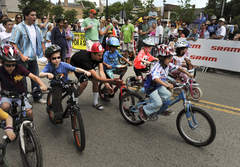
Streets throughout Glencoe were shut down Saturday as two wheels replaced four on the roads for the sixth annual Glencoe Grand Prix bike race.

Cyclists of all levels and ages clad in colorful lycra jerseys competed throughout the day in a series of heats culminating in the men’s and women’s pro races, part of the US Cycling Criterium tour.

The Grand Prix, presented by AT&T and benefitting the Glencoe Educational Foundation was a true community event, with Glencoe residents along the track taking in the competition in from the convenience of their front yard.

“When else can you tailgate on your front lawn,” said local Laura Lederer, surrounded by a yard full of chairs.

Families watched as riders zooming by competed in ten different categories ranging from a Kid’s to Master’s races.

Laura Van Gilder, who came into the race ranked second on the tour, took first place in the Women’s pro race thanks largely to a breath-taking sprint to the finish against Erica Allar.

“That was a tough last leg, Erica Allar has been sprinting well all season,” said Van Gilder. “She has been my primary competition so I’m glad to come out and get the win today.”

The men’s pro race was a two-man affair as Jackie Simes and Rudolph Napolitano pulled away from the field early, en route to a nearly two-minute lead on the rest of the field.

Finishing in equally as thrilling style, Napolitano and Simes duked it out to the end of the last sprint with Simes managing to pull away for the win in the end after almost getting knocked into the barricades lining the street.

“I was able to get the better of [Napolitano] at the end of the sprint,” said Simes. “We got a little close there at the end but it was a clean sprint to the finish.”

On hand for all the races was actor Matthew Modine, acting as Grand Marshall of the event.

Modine, who plays Deputy Commissioner Foley in the upcoming Batman movie, The Dark Knight Rises, was on hand as Grand Marshall of the event.

The actor, an avid cyclist attending his first bike race, donated $30,000 worth of bikes to Glencoe Grand Prix-affiliate West Town Bikes as part of his Bicycle For A Day Foundation.

“Riding a bike is something that has an immediate positive effect on the environment as well as our bodies,” said Modine. “The goal for Bicycle For A Day is for there to be a day for the whole world to come together in solidarity against climate change.”

The race has come a long way since it’s inception six years ago, evident by the amount of riders and the skill level of those involved.

“It really couldn’t have gone any better,” said Grand Prix Coordinator Jon Kerr. “We’ve taken steps each year but this time we really got it right.”

Q and A: Matthew Modine

By Jake Krzeczowski

June 4, 2012 9:40AM

Updated: June 4, 2012 10:09AM

Original: Pioneer Press

Actor Matthew Modine was in Glencoe this weekend as part of the Glencoe Grand Prix festivities. We talked to Modine about his efforts to promote bicycling, and his latest work in Hollywood.

What is the mission behind Bicycle For A Day?

I was asked by a group of young global leaders what I would do to help the environment and I said ride a bike. Riding a bike is something that has an immediate positive impact on our community. In addition to that, riding a bike a couple hours a week can reduce a person’s risk of heart attack and stroke by 50%. The goal for Bicycle For A Day is to have a day the whole world only rides bicycles for a day.

What drew you to Glencoe for the event?

Chicago in general has been great for bicycling with all that Mayor Daley did with bike lanes and whatnot. Chicago is definitely one of the leaders in the country for cycling. I had been working in town with an alternative energy program in the area and was offered the chance to take part in the Grand Prix because of my involvement with Bicycle For A Day.

How does Bicycle For A Day give back?

Biomega, a sponsor for BFD had $30,000 worth of returned bikes at their headquarters and offered to donate them to us. I was going to bring them to New York but heard of West Town bikes who give bicycles to kids who can’t afford bikes and teach them how to fix them and maintain them which is a big part of cycling culture, everybody wins.

What can you tell us about The Dark Knight Rises?

Everyone’s talking about The Avengers and I’m sure it’s a very good movie because I haven’t seen it but I’ll tell you that The Dark Knight will kick it’s butt. It’s very dark and tragic and it’s very good. I’m excited about it.

Glencoe second graders get history lesson with walking tour

By Jake Krzeczowski For Pioneer Press

May 29, 2012 3:42PM

Story Image
Updated: May 31, 2012 3:53AM

Dozens of second-graders flooded into the garden of the Eklund Historical Center in Glencoe, snatching bags of pretzels and water bottles along the way.

In the middle of the scrum, Barney Berlin, corresponding secretary of the Historical Society directed the children with his thick wooden cane.

The kids were at the center on May 24 for the annual South School Historical Day and Berlin tactfully organized the students and parents into groups like a general preparing for battle.

“I’ve been helping with the (annual event) since I retired about four or five years ago,” Berlin said. “It’s fun, it really gives kids a chance to see things they normally wouldn’t, like our wind-up 78 rpm phonograph.”

The South School Historical Day is part of a year-long second grade social studies curriculum that focuses on teaching students about their own towns and neighborhoods.

South School Principal Molly Cinnamon said the visit corresponds to “my community” curriculum that encourages students to actively learn about their own community.

“We have a three day experience for them to do that,” she said.

Along with the visit to the Eklund Center, South School second-graders also participated in a walking tour of Glencoe guided by parents.

Chosen sites were marked with balloons and parents read to the students from packets they were given.

As students crowded around the center’s “Touch Me Table,” one looked at the typewriter in front of him.

“Where is the backspace key?”

The program and the current site of the Eklund Historical Center at 377 Park Avenue have been around for just over a decade and have benefitted from each other by hosting the annual event.

Aside from tours and exhibits, the Eklund Center also offers community research.

The colonial-style site was donated to the Historical Society following the passing of Sally Eklund in 2003.

“It’s a true picture of the community coming together,” said Catherine Wang, director of curriculum and instruction for District 35.

While the kids milled about the different exhibits in the Eklund Center, Wendy Gale and Fran O’Connor watched intently, taking mental notes.

“We’re in charge of putting this on next year for our children,” Gale, mother of a first-grade student said. “It’s a great way for the kids to connect with the community they live in and get a sense of the culture.”

AN AMERICAN EXILE

Verum Magazine, March 2012

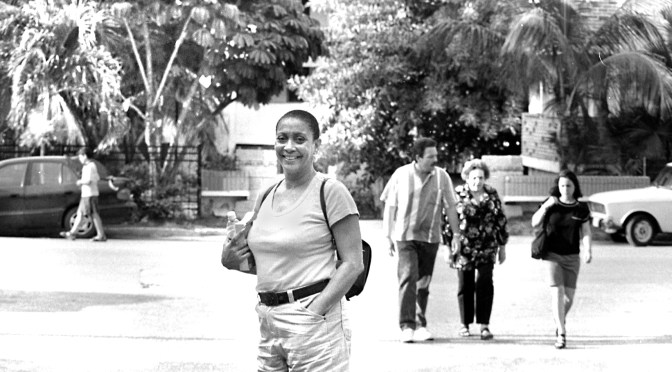
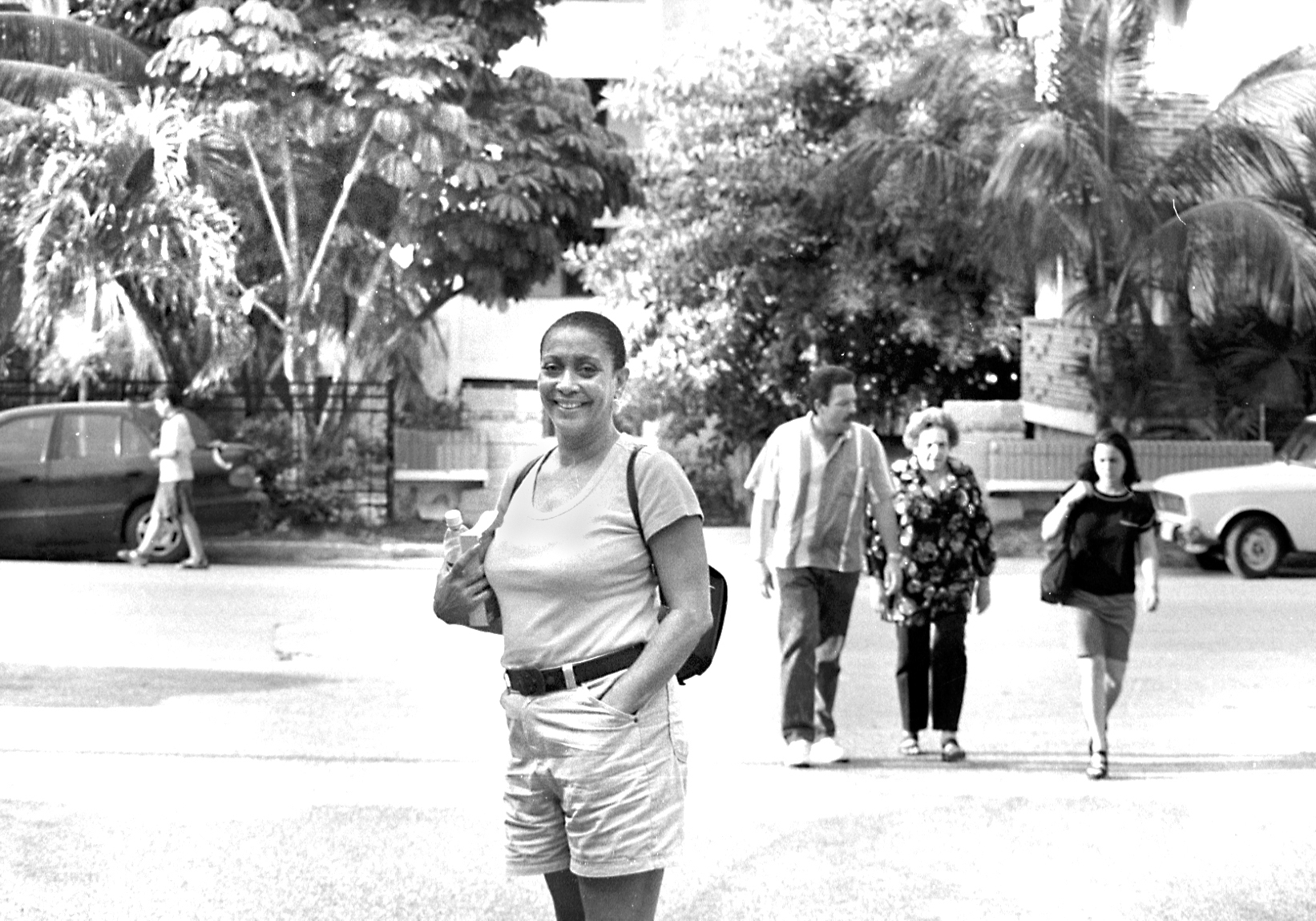
Over winter break this year I was able to go on a two week study abroad writing class to Havana, Cuba. While I was there I was introduced to Nehanda Abiodun, currently living in Cuba under political asylum. After meeting briefly I asked to do an interview and the next day found myself in  on the outskirts of East Havana with just my photographer and a backpack filled with notebooks and cameras. Sitting for three hours in the bright Cuban sun with Nehanda was an unforgettable part of the trip but the story of how she got there in the first place is even more intriguing.

The Revolution Will (Literally) Not Be Televised

Track 1: “And now I’m like a major threat, Cause I remind you of the things you were made to forget” – 2Pac

Somewhere in the U.S., 1989

The monotonous tone of helicopter blades chopping at the brisk late afternoon air snapped her suddenly from intense concentration; “Ok, what will it be?” Nehanda Abiodun stood before her open closet, carefully investigating its contents as the walls closed in from all sides. Knowing full well that her spot on America’s Most Wanted list would warrant a parade of her image across TV stations and newspapers should she be captured, she took her time deciding precisely what to wear. “Something that won’t get dirty easily, something that won’t wrinkle,” she thought to herself, carefully fingering through the hangers. Sirens sounded in the distance.


Havana, Cuba – 2012

Sitting on the creaky red bench attached to one of two tables at Los Pollos, a state-owned fast food chicken bodega in the cluttered public housing section of Havana, Cuba known to us as La Bahia I began to wonder if she would actually show up. Popping a chicken croqueta in my mouth and washing it down with an orange soda I saw her approaching from across the street, trading pleasantries with seemingly everyone who walked by.

Pulling herself away from the crowd Abiodun approached my photographer Louis and myself, wrapping us into a hug that seemed meant for an old friend. Puzzled looks followed her as she embraced the two tank-topped pale Americans. Grabbing three Bucaneros from the bodega, she sat down doling out the take, “Let’s do this,” she said with a crack of the can, a smile crossing her face.

“Besos.”

Nehanda Abiodun, previously known as Cherie Dalton, holds a degree from Columbia University and a host of 32 felonies against her in America. She was third on the FBI Most Wanted list during her heydey in the late 70s for her involvement in the Lincoln Detoxification Center, a drug rehabilitation complex with a revolutionary message. Whether they are all warranted is up for debate. What isn’t however is the revolutionary spirit of the movement that she and her comrades were a part of.


Track 2: “Give the crack to the kids who the hell cares? One less hungry mouth on the welfare.” – 2pac

The phone rang, another interruption in her decision-making process. Carefully, she picked up the receiver without saying a thing. The voice from the other end informed her that police had set up road blocks around her neighborhood, were handing out photos of her asking for information. Muttering a quick thank you, Nehanda put the receiver back.

They were close; moving in.


Three decades ago, at age 30, Abiodun had had enough with community work. Seeing little positive results from her work within the system, along with the killing of a young boy by police in her neighborhood she felt compelled to do more.

“I felt I had to do everything I could to stop things like that from happening,” Abiodun said. “That’s when I decided to go about a more revolutionary path of bringing about human rights and the ending of ‘badisms’ that exist in the United States.”

To be a patient at Lincoln Detox and Acupuncture Clinic you had to take political education classes, do community work,” Abiodun said. “Doing community work, you were no longer a parasite on your community, you’re giving something back and getting a different outlook on yourself”

New York Comptroller Ed Koch, who would later go on to be Mayor and other members of the government had been keeping a keen eye on the center and it’s revolutionary ideals eventually closing Lincoln with a raid of nearly 100 NYPD officers and SWAT team members. The raid occurred at night, with only five or six attendants on duty, none of whom were Abiodun.

Lincoln was overseen by revolutionaries  like Mutulu Shakur and had loose ties to a string of Brink’s truck heists during which several police officers and security guards were harmed or killed. The attempted heists resulted in the jailing of several members of the group, also connected to the Black Liberation Army (BLA).

Stemming from the closing of the center, the attempted heists and the liberation of Assata Shakur in 1979, Abiodun was facing several charges under the Rico Conspiracy Act which deals with being a part of illegal organization for personal gain and had previously only been used in mob cases. She was also implicated in the escape of Assata.

“They say I and others were involved in expropriations of armored trucks, that we were also engaged in the ‘liberation’ of Assata,” Abiodun said. “Personally they say I was involved in the expropriations and aiding and abetting Assata’s liberation.”

The 32 felonies levied against Abiodun, likely a life sentence if tried, are the most of anyone involved in the liberations and “revolutionary” work.


Track 3: The war on drugs is a war on you and me, And yet they say this is the Home of The Free. – 2Pac

It had been eight years since skipping town on the grand jury. Eight years of living out of the public’s eye throughout America and it had come to this. Taking a deep breath she grabbed a pair of dark pants, black shirt and grey sweater. As sirens sounded in the distance, she dressed in a hurry; took a moment to smooth things over in the mirror and soaked in what very well could be her last moments of freedom.

As she put the car into gear and rolled out of the driveway, reversing to the street, she glanced in the rearview mirror, “Here we go,” she said to herself. Dropping the gear from R to D, the car jumped and she turned the corner out of her neighborhood for the last time.

It wasn’t long before what her friend had told her on the phone became reality. Sitting in a long line of cars, she peeked around those in front of her where she saw the black and white of police cars, officers stopping each vehicle with a document in their hands. With a car in front and behind her, a barricade ahead, Nehanda had nowhere to go; slowly inching toward fate.

After the breakup of Lincoln and the subsequent backlash that followed the failed attempt on a Brink’s truck, Nehanda skipped town describing it as “underground”. With a legitimate ID, a job and a home she was well within the reach of American forces but she managed to stay out of their way, for awhile.

She had been called by a Grand Jury to testify against Mutulu, but she refused and went into hiding believing the charges against her and others were bogus.

“At the first trial there was a ledger for all the money that was liberated, robbed, whatever went to do what?” Abiodun said. “To build the clinic, to finance a camp for kids, to help kids with college money. I still have people asking me ‘what happened to the $4.5 million, there must be a stash.’ Well if there is, no one’s told me.”

Speaking to Nehanda about the decades that followed is difficult, highlighted by half sentences, pauses and smiles followed by reminders not to talk about certain things. For obvious reasons, Abiodun is conservative about what she says and does. After all, she spent eight years underground across America. Helped by those sympathetic in the struggle she managed to maintain a semblance of a real life with her children still in New York.


Track 4: “And even to this day they try to get to her, But she’s free with political asylum in Cuba” – Common

As the officer approached her mouth went dry and she swallowed hard to clear her throat, thinking about the hectic schedule of the next couple of days would hold if she were recognized. A rapping on the window broke her reverie, bringing her back to the present. An officer stood outside her window, a similar bored look on his face. She rolled the window down slowly.

“Hello ma’am,” the officer said from behind thick black aviator sunglasses. “Have you seen this woman?”

She reached out and met the officer’s hand at the window,flipping the photo over over in her grip.

Nehanda had expected to see the picture, she had seen it almost everywhere for the better part of a decade: newspapers, magazines; repeatedly on television. This time though, tracing the photo quickly with her eyes she hardly recognized the woman she held in her hands in black and white. She followed the smile on her face to the dread-locked black hair she now wore up in a hat. The photo had been snapped a lifetime ago.

“Never seen her” she said, handing the picture back hoping he wouldn’t notice.

He didn’t.

Feeling herself slowly breathing again she passed by the cars and wooden blockades that made up the stop under the watchful eyes of the other officers before turning the corner and hitting the highway. It was late 1990. A couple months later she would arrive on the shores of Havana, Cuba; leaving the U.S. for good.

If Abiodun thought she had seen struggle in America, her arrival in 1991 in Havana was sure to open her eyes up to more. When asked how she got there she says matter of factly, “I didn’t walk on water.” The year marked the beginning of what Fidel Castro called “the special period” in Cuban history. Following the fall of the Soviet Union the country went through a time of intense economic collapse, felt most harshly by the people. It was normal for condoms to be shredded to mask a lack of cheese on pizzas.

“During the special period, people were just so united. If I had something and you needed it there was no questions of sharing it and vice versa,” she said. “I got used to holding on to things because you never knew when you might need it.”

She had arrived on the island fresh from her own revolution and eager to continue her support from abroad. The Cuban government granting her political asylum, however, had other plans. They ordered her to stop, to relax, allowing Nehanda the first semblance of peace she had felt in almost a decade of living underground.

“I’m really, really grateful to (the Cuban government) for insisting that I take a rest because I had spent eight years underground and even though I thought I was normal, I wasn’t. It had psychological repercussions, being underground all that time.”

Abiodun speaks of the pain she felt leaving her children behind initially, not being able to see friends or family members and a pesky habit of waking up in the middle of the night.

Life outside of the United States hasn’t been easy. Cuba, the only country listed as “self-sustaining” by the World Wildlife Foundation has it’s downsides. While she is appreciative of everything the people and government have done for her, there are times she feels it weighing on her.

“I’m comfortable,” Abiodun said. “I feel safe here. I have stress but it’s not the same stress if I was back in New York right now. I don’t worry about being put out of my house, about not eating.”

Politics now on the backburner, Abiodun had a chance to try something new. She began working in communities throughout Havana, blending into her community, picking up spanish word by word. It wasn’t long before her reputation preceded her and she was sought out.

Those looking for Abiodun however weren’t FBI operatives or military officials, but young hip-hop acts in Cuba looking for insight to the turbulent sixties and seventies in America; they wanted to hear about the struggle.

“I’m spoiled,” Abiodun said. “The youth that I see for the most part are very progressive, politically aware, involved in some sort of movement.”

The genre of hip-hop, mascaraded in America with showers of dollar bills, platinum grills and twenty-inch rims has taken on a different role in the land of socialism. It is a political tool of sorts in a country where there are few. Lyrics often work as a commentary on the government, confronting, within bounds, the issues they face.

Before long, Nehanda was tending to groups of Cuban rappers, often nearly a dozen at a time sitting on the floor of her apartment, looking to her for inspiration that is impossible to ignore when she speaks of listening to Malcolm X live or standing on protest lines at the age of ten.

Track 5: “In case you don’t know, I ride for Mutulu like I ride for Geronimo” – 2pac

During her time in New York during her community and revolutionary work there she came to be friends with a woman named Afeni Shakur, future member of famed American rap artist Tupac Shakur. For the first thirteen years of his life Tupac grew up playing and spending time with Nehanda’s children.

“Tupac was a year older than my son, but they played together like most kids that age.”

Abiodun was among those who impressed a revolutionary, socially aware spirit on the young Tupac Shakur was first impressed upon him. That politically aware mindset has carried over to her teachings amongst the Cuban hip-hop youth. Many come to hear the teachings she learned through time spent with the likes of Mutulu and Assata and the do it yourself mindset of their resistance to perceived biases around them.

She was first introduced to the hip-hop community by Dana Kaplan, then a young American college student studying at the University of Havana.

“While I was there I kept getting all these questions about the civil rights movement and racial justice issues in the U.S.,” Kaplan said. “Nehanda has a great historical perspective, I made sure they could have direct access to her, eventually she was hosting discussion groups in her apartment.”

Around the turn of the millennium the Cuban government declared hip-hop “an authentic expression of Cuban Culture,” and Fidel Castro called it “the vanguard of the Revolution.” The art form had jumped American borders and the locals were hungry.

Abiodun obliged,  bringing the Black August Hip Hop festival to Havana in 1999 along with the Malcolm X Grassroots Movement of the U.S. The festival has hosted the likes of Mos Def, Common and The Roots. Today Black August is one of the most important hip-hop organizations in the country.

Track 6: “It ain’t easy, being me. Will I see the penitentiary or will I stay free” – 2pac

Life in Cuba isn’t perfect. While citizens don’t worry for basic necessities, luxuries are seldom. The government is nearing a change as the Castro brothers age every day and it is the Cuban hip-hop groups that have increasingly looked to be the voice of the youth.

Since she was ten years old Nehanda Abiodun has sought to stand up for the change she feels is right for the world. She has sacrificed her family and her freedom but the only thing she regrets is not having done things a bit smarter. She is at peace with her life but of course would jump at the chance to return to America without jail time.

Whether she is lending her teachings to the young people of Cuba or fighting for equality in “The Land of the Free,” Abiodun has never stopped pushing for what she believes in as others forced her to adapt.

“When I meet my ancestors I want to be able to look them in the eye and say ‘yes I made a lot of mistakes, but I tried my best. That’s what I really want.”

By Jake Krzeczowski

(scenes in italics early on are not necessarily how things happened)

Glencoe Grand Prix is June 2

By Jake Krzeczowski For Pioneer Press May 28, 2012 8:30AM

Story Image

Updated: May 29, 2012 11:56AM

On June 2 hundreds of cyclists will converge on Glencoe for the annual Glencoe Grand Prix.

Growing from a small race in 2007, the Grand Prix has blossomed into a full-scale professional contest featuring riders from all over the country.

The event, hosted by the Glencoe Educational Foundation (GEF), features a series of activities for the community including appearances by Golden Globe award-winning actor Matthew Modine who will serve as Grand Marshall of the event.

Modine, who will appear in The Dark Knight Rises this summer, is an avid cyclist himself who is the founder of the Bicycle for a Day Foundation.

Through a partnership Modine has with Biomega he was able to donate $30,000 of bikes to West Town Bikes on the West Side of Chicago.

The bikes are part of an initiative at the bike shop to educate kids about bike maintenance and safety. At the end of the program, each child recieves a bike.

As part of his Grand Marshall duties, Modine will host a talk at Alberto’s Cycles in Highland Park to discuss cycling, his career and the mission behind his foundation.

“Matthew was just a great fit for the race,” said Jon Knouse, President of the GEF and Director of the Grand Prix said. “His love for cycling and charity just matched up great with what we are trying to do.”

Part of the week-long activities surrounding the Grand Prix is the Family Fun Ride on May 31, which allows parents and children to take a spin around the professional course on their own two wheels.

The Grand Prix is able to attract professional-level riders because of its inclusion in the USA Cycling National Criterium, the official tour for cycling.

“We’re on the national level in terms of racing,” Knouse said. “We have riders coming from all over the country, international riders. Beyond the professional races we also have a series of amateur races.”

One of those racers is a local talent, Mike Sherer of Winnetka, who won the race in 2010. After missing last year’s race due to injury he is eager to get back on the familiar track.

“The race is about five blocks from my Dad’s house,” Sherer said. “All the races in the North Shore have a special place in my heart and I’m coming in ready to go.”

The race was started in 2007 as a way to raise money for the Glencoe Educational Foundation, which benefits schools in the Glencoe area as well as select Chicago public schools.

“We used to have a dinner in the winter time to complement the bike race in the summer, but the race got so big that we dropped the dinner altogether in 2008 and focused on the race,” Knouse said.

In 2010 the Grand Prix was awarded the National Championship for the Criterium schedule which has kept it on the tour schedule ever since.

“The Glencoe Grand Prix is a big deal for a lot of people,” Grand Prix Media Director Jon Kerr said. “It really has grown into something special.”

Glencoe’s West School kicks off Fitness Week

By Jake Krzeczowski For Pioneer Press May 21, 2012 4:42PM

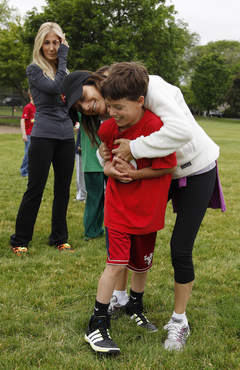
Susie Sherman hugs her son Jacob after she played soccer in his gym class during Fitness Week at West School on Monday. | Joel Lerner~Sun-Times Media

Updated: May 22, 2012 9:45PM

Moms and dads in sweats and gym shoes exchanged nervous smiles and raised eyebrows as a dozen third graders skipped into the brightly lit gymnasium of Glencoe’s West School, grabbing their parent’s hands and pulling them into the fray amid a collective smile.

May 21-28 marks Fitness Week for District 35’s West School, allowing a chance for parents to drop in throughout the week and participate in physical education classes with their kids. Fitness has been celebrated across the district this month.

“Instead of just having parents watch, we like to get them involved and see things first hand,” said physical education teacher Hillary Lee.

Lining up cross-legged on the floor, students and parents listened intently as Lee explained the rules of the soccer game they were to play, a warning to be careful seeming to be meant more for the parents than the kids.

“We had one dad go down earlier today,” Lee said. “But he was fine, the kids got a good laugh.”

After instructions, parents and kids moved out to the fields surrounding the school for the game, dividing into teams of red and blue.

Students at West School normally participate in PE four days a week and while it is not required for parents to attend, many show up several times throughout Fitness Week to spend time in class.

“This is my tenth year doing this,” said mother Becca Friedland. “It’s a great way to come out and show kids that exercise can be fun.”

As a nine year old in a Blackhawks shirt dribbled past a mom in yoga pants Lee explained that the program, which has been around for more than 20 years, is a great way for families to spend quality time together while advocating for a healthy lifestyle.

The week also comes on the heels of a visit to Chicago by First Lady Michelle Obama for the NATO Summit, herself a large supporter of healthy lifestyle choices through her “Let’s Move” campaign.

While Lee says she feels most of the students have no problem living healthy, it never hurts to have an adult role model to follow, hence bringing in parents and other family members.

One participant, grandmother Beatrice Cho, arrived at the school while still getting acclimated from a long trip to Korea early last week.

“My schedule has been so crazy since we got back that I’ve hardly slept, but I made a point to make it here for my granddaughter,” Cho said.

The kids also enjoy the competition.

“It’s fun to play with my mom because she’s better than me at soccer,” third-grader Shane Michelon said. “Plus she always passes me the ball.”

At the end of the half hour class both teams met in the middle, exchanging high fives and hugs. As they filed out of the field and back to the gym two of themothers glanced at each other with smiles on their faces.

“Same time tomorrow?”